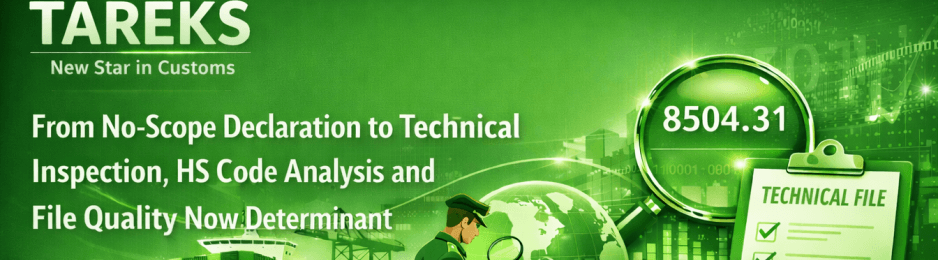
<p>As of 2026, the changes introduced in <strong>Türkiye’s TAREKS (Risk-Based Foreign Trade Control System)</strong> do not merely constitute a procedural update; they represent a structural transformation that fundamentally reshapes the approach to import controls under <strong>Turkish customs and product safety legislation</strong>. In particular, the effective abandonment of the traditional concept of “no-scope declaration” has created a new inspection reality for companies importing goods into Türkiye.</p><p>Under the new Turkish practice, declaring that a product is outside the scope of a specific product safety regulation is no longer an exception that accelerates customs clearance. Instead, such a declaration now serves as the <strong>starting point of technical and regulatory inspection</strong> carried out through TAREKS.</p><p>Within this framework, TAREKS has evolved from a system that merely filters products subject to control into a <strong>central inspection mechanism</strong> under Turkish law, requiring even allegedly out-of-scope products to be assessed from <strong>technical, legal, and functional perspectives</strong>. The most visible consequence of this transformation is the significantly increased importance of <strong>HS Code (GTİP) analysis</strong> and <strong>technical file quality</strong> in imports to Türkiye.</p>