
Turkey Customs & Trade Compliance Consultancy; Fast, traceable, clear. Not AI — Real Expert Opinion.
Describe your case and attach documents if needed. We run an automated pre-check and return a clear quote and target delivery time. Your answer is prepared by experienced customs professionals.
- • Minimisation of risk and cost through accurate declaration and compliance
- • Full integration with ConspheraPSA to manage processes through a single channel
- • Process transparency, traceability & team management in corporate membership
- • Fast delivery with clear SLAs: customs consultancy at the right time, right cost
⚖️
Get Real Expert Advice — Not Artificial Intelligence
Most Accurate Results with Our 15+ Years Experienced Turkey Customs Consultants.
⚡️
Instant, Tailored Quote for Your Question
The Consphera PSA engine reviews your case and prices it against dozens of criteria, speeding up the process.
🏢
Corporate Membership
Authorize your team and manage all questions and usage from a single dashboard.
🔋
More Value with Credits
Buy credits in bulk and get the same quality with tiered discounts.
Turkey Customs & Trade Compliance – Scope of Advisory Coverage
EasyCustoms360 focuses exclusively on Turkish customs law and trade compliance matters affecting foreign exporters, manufacturers, legal teams and importers operating with Türkiye.
Our advisory scope covers core risk areas such as customs valuation disputes, rules of origin and preferential treatment, anti-dumping and trade defence investigations, import surveillance measures, technical regulations, and HS classification issues under the Turkish Customs Tariff Schedule.
Given the frequent regulatory changes and strict enforcement practices in Türkiye, even minor compliance gaps may lead to delays, penalties or retroactive duties. Our platform provides structured, expert-driven analysis to help businesses understand regulatory exposure before shipment, during customs clearance and in post-clearance audits.
Why Turkey Customs Compliance Matters for Foreign Exporters
For exports to Türkiye, customs compliance is not a mere formality; it is a direct cost and commercial risk driver embedded in the entire supply chain. Errors or inconsistencies in customs valuation, origin determination, import surveillance measures or trade defence procedures frequently trigger shipment delays, document rejections and intensified controls at the border. In many cases, these issues escalate into administrative penalties, retroactive duty assessments and extended post-clearance audits, creating financial exposure well beyond the initial transaction value.
For this reason, foreign exporters and importers working with Türkiye should proactively monitor regulatory changes and closely assess administrative practice risks throughout the trade lifecycle. Early identification of compliance gaps enables businesses to mitigate disruption, control costs and maintain continuity in their trade operations with Türkiye.
Our Core Expertise in Turkey Customs
HS Code Classification & Binding Opinions
Accurate HS classification, technical file alignment, and support for binding tariff information to reduce clearance risk and disputes.
Customs Valuation, Assists & Cost Elements
Transaction value setup, assists/royalties/freight/insurance handling, and defensible valuation files aligned with Turkey customs practice.
Origin, Supplier Declarations & Preferential Trade
Rules of origin assessment, EUR.1/ATR workflows, supplier declarations, and preference eligibility checks for Turkey-focused trade flows.

Technical Regulations, TAREKS and TPS-Based Compliance Review
Review of CE marking, labelling, declarations of conformity and technical files for compliance with the Single Window System (TPS) and TAREKS procedures, focusing on preventing rejections and clearance delays through pre-declaration compliance checks.
Post-Clearance Review & Audit Readiness
File completeness, risk mapping, and support for post-clearance control scenarios to keep corrections and penalties under control.
Objections, Litigation & Customs Dispute Strategy
Assessment of objection/litigation options, preparation of objection files and litigation strategy; voluntary disclosure and post-clearance dispute handling.
Featured Services
🔎
Corporate Subscription
Manage your organisation's consultancy needs through a single channel.
Start NowEasyCustoms360 News
Latest Posts
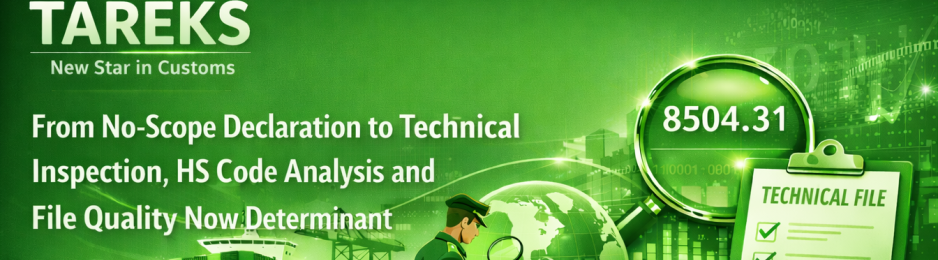
TAREKS in Türkiye: From No-Scope Declaration to Technical Inspection
As of 2026, the changes introduced in Türkiye’s TAREKS (Risk-Based Foreign Trade Control System) do not merely constitute a procedural update; they represent a structural transformation that fundamentally reshapes the approach to import controls under Turkish customs and product safety legislation . In particular, the effective abandonment of the traditional concept of “no-scope declaration” has created a new inspection reality for companies importing goods into Türkiye. Under the new Turkish practice, declaring that a product is outside the scope of a specific product safety regulation is no longer an exception that accelerates customs clearance. Instead, such a declaration now serves as the starting point of technical and regulatory inspection carried out through TAREKS. Within this framework, TAREKS has evolved from a system that merely filters products subject to control into a central inspection mechanism under Turkish law, requiring even allegedly out-of-scope products to be assessed from technical, legal, and functional perspectives . The most visible consequence of this transformation is the significantly increased importance of HS Code (GTİP) analysis and technical file quality in imports to Türkiye.

Customs Valuation of Assists, Engineering and Development Costs
One of the most technically demanding and dispute-prone areas in customs valuation concerns buyer-supplied goods and services, including engineering, development, design and technical services, as regulated under Article 27(1)(b) of the Turkish Customs Law. These elements, commonly referred to as assists, rarely remain a simple valuation adjustment in practice. Particularly in transactions between related parties, assists often evolve into a complex and multi-layered compliance risk.

The Importance of Service Invoices in Determining Customs Value (According to Turkish Customs Legislation)
The concept of customs value is arguably one of the most debated and disputed topics in customs legislation. The main reason is that the customs value of imported goods must be determined based on the specific conditions of the commercial transaction.